A visionary anonymous donor has funded our current awards and prizes as follows:
Memory Decoding Challenge Prize is currently $100,000. It will be offered to the first author of the team that makes this historic achievement, upon publication in a peer-reviewed scientific journal. There is no time limit for this award.
Annual Research Awards are currently US $25,000 (split equally among co-awarded papers then split equally among co-first authors). Four awards are presently offered each year typically during or around the time of the Society for Neuroscience meeting in November. Papers are selected from the annual nominations. Current philanthropic commitments will hopefully allow us to offer these annual awards until 2030.
Previous Aspirational Neuroscience Award Winners:
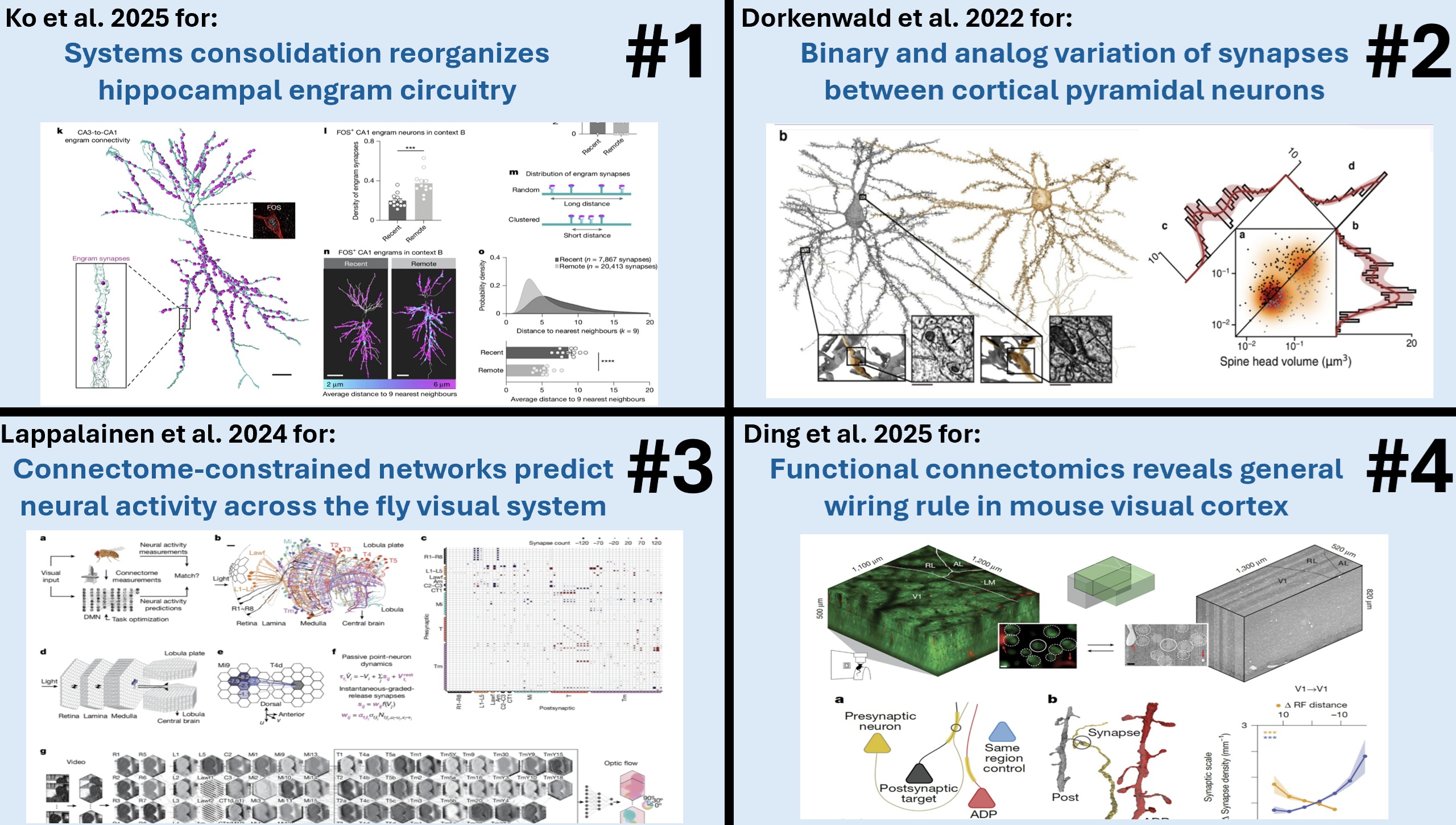
2025 Awards:
2023 Awards:
2019 Awards: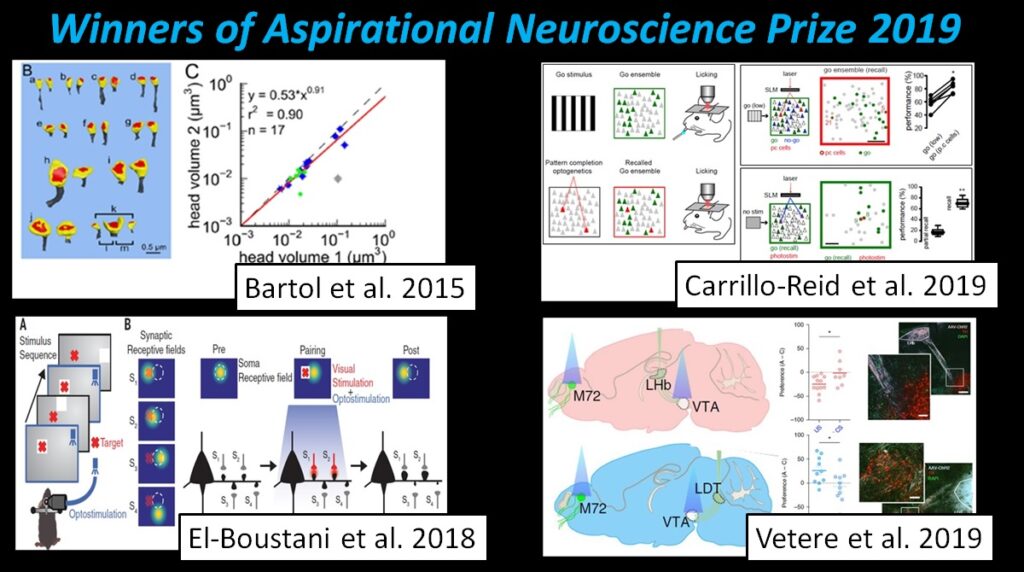
The Aspirational Neuroscience Awards exist to honor and highlight groundbreaking scientific to research into how learning and memory are physically encoded in the brain. These awards are highly competitive, with consideration given to all peer-reviewed neuroscience publications worldwide since the previous award ceremony. So far the awards have been offered three times (2019, 2023, 2025), and they will be awarded again in 2026 (and annually thereafter).
The awards are granted based on the scientific impact, originality, and rigor of the work. A central criterion for selection is that the research must represent a significant milestone in either – 1) the understanding of; or 2) tools to examine – the neurophysiology of memory.
From thousands of eligible publications, a shortlist is nominated and only four papers are selected, representing the highest tier of scientific excellence and innovation in neuroscience.
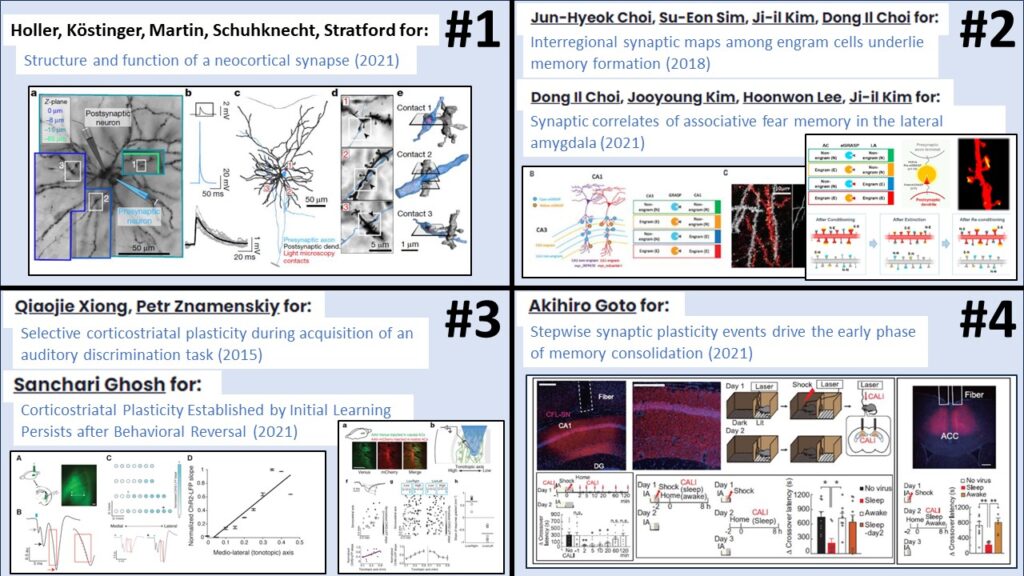
2023 Aspirational Neuroscience Award #1:
Holler, Köstinger, Martin, Schuhknecht, Stratford for:
Holler et al. 2020 “Structure and function of a neocortical synapse”
This impressive study found a linear relationship between synapse size and strength, providing the missing link in assigning physiological weights to synapses reconstructed from electron microscopy. This work supports the potential for inferring a synapse’s electrophysiological properties from structural imaging, a key step on the path to decoding information from static brain structure.
2023 Aspirational Neuroscience Award #2 (Shared):
Jun-Hyeok Choi, Su-Eon Sim, Ji-il Kim, Dong Il Choi for:
Choi et al. 2018 “Interregional synaptic maps among engram cells underlie memory formation”
Dong Il Choi, Jooyoung Kim, Hoonwon Lee, Ji-il Kim for:
Choi et al. 2021 “Synaptic correlates of associative fear memory in the lateral amygdala”
These studies were recognised for their extraordinary contribution to understanding how memory is encoded at the structural and molecular levels. These landmark studies were the first to visualize and quantify the “synaptic engram” in the hippocampus and amygdala—an essential mechanism by which memory is stored in the brain. The work was especially notable for demonstrating how memory strength correlates with the number and size of synapses among engram cells, marking a breakthrough achievement in the field.
2023 Aspirational Neuroscience Award #3 (Shared):
Qiaojie Xiong, Petr Znamenskiy for:
Sanchari Ghosh for:
These pioneering studies revealed how the brain establishes and maintains learned associations between sounds and actions through selective strengthening of corticostriatal synapses. The work demonstrated that learning creates specific patterns of synaptic plasticity along tonotopic gradients in the striatum that precisely encode stimulus-action associations, and remarkably, these patterns persist even after behavioral reversal. This research provides fundamental insights into how neural circuits transform sensory information into learned behaviors through targeted synaptic modifications.
2023 Aspirational Neuroscience Award #4:
Akihiro Goto for:
Goto et al. 2021 “Stepwise synaptic plasticity events drive the early phase of memory consolidation”
This groundbreaking study revealed the precise spatiotemporal choreography of synaptic plasticity during memory consolidation, demonstrating distinct waves of LTP that occur in the hippocampus and cortex at specific times after learning. The work introduced a revolutionary optogenetic tool for selectively erasing LTP with unprecedented temporal precision, uncovering how online and offline plasticity events differentially shape memory engrams. This research provides a mechanistic framework for understanding how memories transition from hippocampus to cortex through orchestrated synaptic modifications during sleep.
2019 Aspirational Neuroscience Award #1:
Gisella Vetere for:
Vetere et al. 2019 “Memory formation in the absence of experience”
2019 Aspirational Neuroscience Award #2:
Luis Carrillo-Reid for:
2019 Aspirational Neuroscience Award #3 (Shared):
Sami El-Boustani and Jacque Pak Kan Ip for:
El-Boustani et al. 2018 “Locally coordinated synaptic plasticity of visual cortex neurons in vivo”
2019 Aspirational Neuroscience Award #4:
Thomas M Bartol Jr for:
Bartol et al. 2015 “Nanoconnectomic upper bound on the variability of synaptic plasticity”
Thank You Neurophilanthropists
Are you a philanthropist interested in advancing humanity’s understanding of complex, high-value questions in neuroscience? Would you like to grow the size or visibility of AN prizes, or establish other research prizes? Contact us. We’d love to talk with you.