
Nominations
Filter By Category:
Distinct synaptic plasticity rules operate across dendritic compartments in vivo during learning
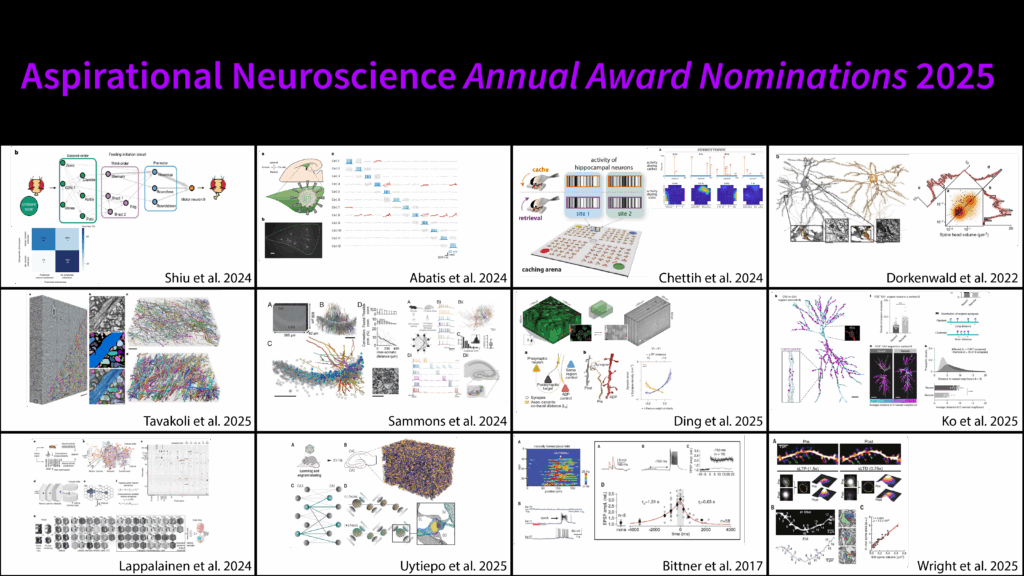
Wright et al. performed two photon imaging in mouse motor cortex while the mouse was learning a motor task (lever press to tone). The authors coexpressed the glutamate sensor (iGluSnFR3) and calcium indicator (RCaMP2) in a subset of layer 2/3 pyramidal neurons. This allowed them to simultaneously monitor the synaptic inputs onto a neuron and the neuron’s response to those inputs over several sessions during learning, and to simultaneously monitor changes in the size of the dendritic spine synapses that constituted the motor learning. In this way the authors could ask the question “What functional correlations give rise to synaptic potentiation?” The authors found that potentiation of an apical spine is predicted by that spine’s chance of being coactive with nearby spines (within 20 microns) and was independent of activity of the postsynaptic neuron itself. In fact, blocking postsynaptic action potentials did not affect this apical spine plasticity. In contrast, potentiation of dendritic spines on the basal dendrites was predicted by coincident of presynaptic inputs with postsynaptic action potentials -suggesting basal dendrites employ something like a Hebbian learning rule.
Behavioral time scale synaptic plasticity underlies CA1 place fields
Bittner et al. recorded from individual CA1 pyramidal neurons in head-fixed mice running along a linear-track treadmill. Initially the CA1 cell was unresponsive but, following a plateau potential initiation (either spontaneously generated or induced by current injection) the CA1 cell now showed a lasting place field response to this location on the track. The authors provide evidence that all of the synapses that had been active within a several second time window centered on the plateau potential are potentiated. Evidence included slice experiments in which the precise timing characteristics of this Behavioral Time Scale Plasticity (BTSP) were measured as well as its sensitivity to calcium dynamics. BTSP’s characteristics are distinct from Hebbian plasticity in that potentiated inputs do not have to be causally related to the post-synaptic cell’s firing, do not have to be coincident on the millisecond time scale, and do not require repeated pairings. In contrast, BTSP seems well tailored to the task of one-shot learning of a place field.
Synaptic architecture of a memory engram in the mouse hippocampus
The authors studied how long-term structural changes establish fear memories on the Schaffer collateral synapses using a combination of 3D electron microscopy, chemogenetic tagging and behavioral analysis. Their results suggest that formation of long-term engrams is associated with a selective presynaptically driven increase in the number and size of multisynaptic boutons, even without the involvement of simultaneous activation of synaptically connected neurons.
Connectome-constrained networks predict neural activity across the fly visual system
The authors used average synapse counts between specific pre-post pairs of neural cell types that were determined using Drosophila brain EM connectome and identified excitatory vs inhibitory connections to model multilayer lattices of stereotyped neural circuit function of fruitfly visual system. The resulting substantially reduced set of free parameters in this connectome constrained model was trained on a motion detection task, which enabled successful prediction of cell-type specific contrast selectivity and motion direction selectivity.
Systems consolidation reorganizes hippocampal engram circuitry
This paper reveals how episodic memories transform from precise to generalized “gist” memories through time-dependent reorganization of hippocampal synaptic architecture. Using eGRASP to visualize engram-to-engram synapses, the authors discovered striking structural changes over 4 weeks of consolidation. CA3-to-CA1 engram synapses not only increased in density but also became significantly more clustered on CA1 dendrites – with inter-synapse distances decreasing as memories aged. This synaptic clustering, known to enhance neuronal activation probability, coincided with “promiscuous” activation of CA1 neurons in novel contexts. Simultaneously, DG engram filopodial contacts onto parvalbumin interneurons decreased, reducing feed-forward inhibition onto CA3 neurons. Adult-born neurons were critical orchestrators – directly contacting CA3 engram thorny excrescences and forming new interconnections between adjacent engram neurons. Eliminating neurogenesis prevented all these structural changes, freezing engram connectivity in a “recent memory state” that maintained precision. Conversely, exercise-induced neurogenesis accelerated synaptic reorganization and gist memory emergence to just 14 days post-training.
Functional connectomics reveals general wiring rule in mouse visual cortex
This paper summarizes some of the key findings of the MICrONS project -perhaps the most ambitious connectomics project to date. The MICrONS project acquired a cubic millimeter volume electron microscopy dataset spanning mouse primary and higher-order visual areas. Overlapping regions were calcium imaged in the awake behaving mouse while watching hours of specially designed video stimuli. This paper analyses a subset of the neurons having both high-quality calcium recordings and proofread connectome tracings. This allowed the authors to ask questions like “Are neurons that respond to similar visual features more likely to be synaptically connected?” The authors employ two novel analysis techniques: 1.) They quantify the distance each axon travels in close proximity to each dendrite. This allows them to normalize the actual synapse density seen between any two cells. 2.) The authors employ a ‘digital twin’ to precisely quantify each cell’s receptive field location tuning and feature tuning separately. Using these, the authors show that cells with similar feature tuning have higher than expected synaptic interconnectivity. Intriguingly they show that cells with similar location tuning show lower than expected synaptic interconnectivity. Results that have significant implications for our models of learning in cortex.
Structure and function of the hippocampal CA3 module
Autoassociative models of how CA3 stores memories typically assume a high degree of recurrent connectivity. This paper quantifies that connectivity. The authors acquired a large (965 x 808 x 62 micron) volume electron microscopy dataset spanning all layers of CA3. Since this volume is thin in one direction, they first identified seven pyramidal neurons with at least two axon collaterals in the volume and reconstructed their entire axonal arbors throughout the volume. They identified all synapses these axons made onto other pyramidal neurons. Using this data, they calculated the probability of such recurrent synapses as a function of inter-somatic distance. They found a local connectivity probability of 11% within 50 microns that dropped to 5.5% within 250 microns. In a separate experiment, the authors performed simultaneous whole-cell recordings of up to eight CA3 neurons in 119 acute mouse hippocampal slices (400 microns thick). They found a probability of synaptic connection of 8.8% which was in line with their EM results. Finally the authors performed computational modeling showing that this relatively high recurrent connectivity supports pattern completion in a spiking model of CA3 memory encoding.
Light-microscopy-based connectomic reconstruction of mammalian brain tissue
This paper’s technique, light-microscopy-based connectomics (LICONN), represents the biggest technological advancement in connectomics in a decade. Until this paper only electron microscopy (EM) techniques had been shown to have the 3D resolution needed to comprehensively trace all neuronal connections in a volume of brain tissue. LICONN allows such comprehensive tracing using fluorescence microscopy. Unlike EM which requires physical sectioning (ultrathin or ion ablation) to obtain 3D over large volumes, LICONN uses optical sectioning. This is an enormous simplification. Perhaps more importantly, the authors demonstrate that LICONN is compatible with immunolabeling of biomolecules like synaptic proteins. This ability to obtain molecularly annotated connectomes opens up many new experimental paths for memory research and memory decoding experiments.
Binary and analog variation of synapses between cortical pyramidal neurons
The authors traced and proofread 1960 synaptic connections among 334 pyramidal neurons in a serial section TEM volume covering layer 2/3 of mouse V1. They quantified the size, and thus functional strength (Holler 2021), of each of these synapses. Plotting a histogram of these synapse sizes showed, instead of the expected log-normal distribution, a highly skewed distribution that was better fit by a mixture of two log-normal distributions. They then analyzed a subset containing 320 of these synapses from 160 matched pairs (two synapses that share the same pre- and post-synaptic cells). Such matched synapses have identical learning history and thus could be expected to be correlated in size. Plotting the histogram of the geometric mean of each matched pair showed an even clearer bimodal distribution which the authors showed could be modeled by assuming each pair had the same binary value (small or large) with an uncorrelated analog noise on top. This is evidence for a Hebb-style learning rule with only two synaptic strength states (small vs large). An excellent example of EM connectomics providing novel insight into one of neuroscience’s most fundamental questions.
Barcoding of episodic memories in the hippocampus of a food-caching bird
In this study, Chettih et al. leveraged chickadees’ natural food-caching behavior – where birds hide seeds in various locations and must remember each cache precisely – to investigate episodic memory encoding. They discovered that each caching event triggers a unique, sparse “barcode” pattern of hippocampal activity distinct from the conventional place code. During caching, most excitatory neurons are suppressed while ~7% fire in brief, high-frequency bursts, creating a site-specific pattern. Crucially, these barcodes reactivate when birds retrieve specific caches, even after 45-minute delays. The barcodes are orthogonal to place cell activity – showing no correlation between adjacent sites just 5cm apart – and both coding systems operate simultaneously in the same neural population. This suggests the hippocampus uses high-dimensional, sparse patterns as unique identifiers for episodic memories, analogous to hash codes in computing.
Fear learning induces synaptic potentiation between engram neurons in the rat lateral amygdala
Previous experiments have shown that the strengthening of excitatory synapses from sensory areas onto Lateral Amygdala (LA) pyramidal neurons provides the specificity of a fear memory (e.g. Nabavi 2014). In this paper, Abatis et al. show how the strengthening of recurrent excitatory synapses among specific LA pyramidal neurons form an autoassociative attractor network which amplifies these inputs sufficiently to trigger the fear response. In their key experiment, they virally label LA engram cells which activated during the recall of a contextual fear memory. They subsequently performed ex vivo 12 cell patch clamp on these engram (and non-engram) cells to test their functional interconnectivity. They find a higher number of synaptic connections, and stronger synaptic connections, among engram cells. This result, combined with their electrophysiological analysis of baseline excitability, suggests that this strengthening of synaptic connectivity forms an autoassociative attractor network underlying the particular fear memory. The implication is that each LA memory is associated with such an attractor network.
A Drosophila computational brain model reveals sensorimotor processing
The authors created a complete leaky integrate-and-fire computational model of the entire Drosophila brain on the basis of an EM connectome and neurotransmitter identities. They demonstrate that the model’s behaviours can accuractely predict the behaviour of biological Drosophila, such as activation of sugar-sensing ‘neurons’ in the digital model predicting biological neurons that respond to tastes.
*2023 Co-Winner!* Synaptic correlates of associative fear memory in the lateral amygdala
Authors use the dual-eGRASP technique (which they developed in Choi et al. 2018) to tag engram populations in both auditory cortex (AC) and lateral amygdala (LA) during an auditory fear conditioning (AFC) experiment. Engram cells in the LA were labeled red (mScarlet) and expressed the post-eGRASP protein. Engram cells in AC (presumed to encode the auditory tone) expressed the Yellow pre-eGRASP protein. As such, synapses from AC engram cell axons onto LA engram dendrites would appear as yellow PSDs onto red dendritic spines (E-E synapses). A random subset of AC cells (non-engram) expressed the Blue pre-eGRASP protein and these AC non-engram to LA engram synapses could be visualized as blue PSDs onto red dendritic spines (N-E synapses). E-E synapses were found to be larger than N-E synapses after AFC. This difference disappeared after AFC extinction but returned after AFC re-conditioning, providing strong evidence that these synaptic changes encode the fear memory in LA.
Visual physiology of the layer 4 cortical circuit in silico
Authors created a biophysically-realistic model of Layer 4 of mouse primary visual
cortex and tuned particular parameters (e.g. synaptic connectivity) as needed to achieve
agreement with a wide variety of in vivo observations from existing literature. The details of the
model, which parameters needed to be tuned, and its agreement (and disagreement) with in
vivo measurements represents “a consistent summary of our collective anatomical and
physiological knowledge about this region”.
Brief description of model: The model consists of 10,000 biophysically modeled neurons (3
excitatory types, 2 inhibitory types) each consisting of 100-200 dendritic compartments. Soma
dynamics were modeled in Hodgkin-Huxley style using 10 different types of active
conductances to model spiking and spike adaptation. Dendrite structure was based on filled
reconstructed neurons of each type. Only passive dendrite dynamics were modeled. Synapses
were modeled using a bi-exponential model with no short or long-term plasticity. LGN inputs
were modeled by a range of spatiotemporal filters distributed across the visual field: “To connect
LGN cells to L4 cells, we created separate “lasso” subfields for each of three LGN types
(transient ON, OFF, and ON/OFF), independently for each L4 cell… For the excitatory L4 target
cells, the choice of the direction in which the ON and OFF lasso subfields were positioned (Fig
7C) was determined by the assigned preferred orientation angle that was set for each L4 cell at
model construction.”
Active dendrites enable strong but sparse inputs to determine orientation selectivity
A fundamental open question in neuroscience is the importance of active dendritic
conductance (leading to local dendritic spikes) to the tuning properties of neurons. The authors
create a compartmental model of a layer 2/3 pyramidal neuron in mouse visual cortex and a
model of its synaptic input (based on previous in vivo experiments) to explore this question.
Authors used algorithmic criteria to identify the spatial and temporal extent of key events such
as Na+ and NMDA dendritic spikes as well as somatic and back propagating action potentials.
This model was tuned to replicate key experimental findings. Exploring the model, authors
conclude that: “Our model provides a mechanistic explanation for how narrowly tuned
orientation-selective responses can arise from dendritic integration of weakly tuned synaptic
input: a few strong synapses, which provide input from similarly tuned presynaptic neurons,
preferentially trigger dendritic spikes. Dendritic spikes in turn are more narrowly tuned to
orientation than the synaptic input and efficiently drive the majority of somatic AP output. Thus,
by triggering dendritic spikes, a small subset of strong synapses drives amplification of
orientation-selective signals, effectively determining the tuning of neuronal output.”
Contribution of apical and basal dendrites to orientation encoding in mouse V1 L2/3 pyramidal neurons
Uses 2-photon dendritic micro-dissection to precisely cut off dendritic branches and see the
effect (after 1-5 days) on the cell’s orientation tuning. Pre- and post-dissection tuning are determined via
calcium imaging of soma while mouse views moving gratings. Result: “Loss of apical input does not alter
orientation preference”, “Orientation tuning is robust to loss of multiple basal dendrites.” Authors create a
range of models whose apical and basal synapses sample from different orientation preference
distributions. They compare these models to their micro-dissection results. This comparison suggests that
each basal dendrite has an orientation tuning that is offset from the soma’s, implying that they learn
somewhat independently. Authors suggest this is evidence of local dendritic learning: “ Such
heterogeneity may arise from dendrite-specific forms of plasticity potentially mediated by spatially
restricted biochemical signaling and/or dendritic spikes.”
*2019 Winner!* Controlling Visually Guided Behavior by Holographic Recalling of Cortical Ensembles
Representations are highly-redundant ensembles (dynamical attractors).
Stimulation of just two ‘pattern completion’ neurons will sometimes recall entire ensemble,
trigger behavior.
Photoactivatable CaMKII induces synaptic plasticity in single synapses
Authors develop a photoactivatable version of CaMKII (paCaMKII) and use it to
directly prove the sufficiency of CaMKII to drive all aspects of LTP (structural and functional) in
individual spiny synapses. They also compared paCaMKII activation of single spines vs.
clusters of nearby spines (5-8 adjacent spines on the same dendrite) and showed that clustered
activation showed enhanced sLTP and Cdc42 activity after 30 minutes.
Hippocampal LTP and contextual learning require surface diffusion of AMPA receptors
Demonstrates that AMPA receptor surface diffusion is crucial to synaptic
potentiation.
Local protein synthesis is a ubiquitous feature of neuronal pre-and postsynaptic compartments
A range of advanced labeling and microscopy techniques are used to dissect the
regulation of local protein synthesis pre- and postsynaptically in response to plasticity induction.
Dense connectomic reconstruction in layer 4 of the somatosensory cortex
Authors developed set of techniques to accurately reconstruct the synaptic
connectivity of all neuronal processes in a region of cortex. They classified processes (e.g.
thalamocortical axon) based on morphology and connectivity, and found many examples of
synapse pairs from the same axon to the same dendrite (thus having identical Hebbian learning
histories). Plotting the mean size of each pair vs. the difference in their sizes showed a pattern
which the authors interpret as evidence of saturated LTP and LTD. They quantify the percentage
of such pairs whose correlation is above chance (relative to randomized null distribution) and
claim to have identified “upper bounds for the fraction of the circuit consistent with saturated
long-term potentiation” associated with particular classes of synapses in the volume. They
suggest that this quantification of “learned fraction” can be applied to other brain circuits as a
general means of studying learning.
*2019 Winner!* Nanoconnectomic upper bound on the variability of synaptic plasticity
Previous studies (including glutamate uncaging experiments) have shown that there
is a correlation between the functional strength of a spiny synapse and its size. Bartol et al.
provide additional evidence by showing how tight size correlates between synapses with
identical histories of pre- and post-synaptic firing. They interpret residual variability to estimate
an upper bound on the precision of synaptic strengths.
Kinetics of Endogenous CaMKII Required for Synaptic Plasticity Revealed by Optogenetic Kinase Inhibitor
Authors directly test a central hypothesis about LTP and learning –that it is
dependent on an immediate, short-duration rise in Ca2+ concentration in spines (via NMDA
receptors) activating CaMKII’s (auto)phosphorylation ability. They develop, and fully
characterize, a novel, genetically-encoded photoactivatable inhibitor (paAIP2) of CaMKII’s
phosphorylation ability. When paAIP2 is activated by blue light it immediately and reversibly
inhibits CaMKII. Authors demonstrate specificity using western blot experiments. They
demonstrate the time-dependence of CaMKII activation for the structural expression of LTP in
hippocampal slices using MNI-glutamate uncaging experiments. They demonstrate the timedependence of CaMKII activation for the electrophysiological expression of LTP in hippocampal
slice stimulation experiments. Finally, in behaving animal experiments, they demonstrate that
bilateral amygdala photoactivation of paAIP2 during inhibitory avoidance training erases the fear
memory.
*2023 Winner!* Stepwise synaptic plasticity events drive the early phase of memory consolidation
Authors hypothesized that “…inactivating CFL [cofilin] would lead to destabilization
of the cofilactin structure within the dendritic spine, thereby permitting selective erasure of
sLTP.” They demonstrated this using a fusion protein of CFL with the CALI photosensitizer
protein SuperNova (SN) creating CFL-SN. Photoactivation of CFL-SN up to ~30minutes after
LTP induction reversed structural LTP at the individual spine level. Using this, the authors
demonstrated 3 distinct phases of memory formation that require LTP. Phase #1 (hippocampal
online LTP) is LTP in hippocampus immediately following the shock event. Phase #2
(hippocampal offline LTP) is LPT in the hippocampus during the first day’s sleep period which
the authors argue is required for ensemble stabilization in the hippocampus. Finally, Phase #3
(ACC offline LTP) is LPT in the ACC during the second day’s sleep and is required for system’s
consolidation.
Optical inactivation of synaptic AMPA receptors erases fear memory
Authors develop an antibody-mediated CALI inactivation technique specifically
targeting ONLY calcium permeable AMPA receptors (GluA1 homomeric CP-AMPA receptors).
Crucially the Ca2+ currents carried by these CP-AMPA are necessary for the protein synthesis
steps needed to convert early LTP to long-lasting LTP. So disrupting these ~1 hour after a
learning event will erase LTP in those synapses encoding that event only while not effecting
other learned events. Authors demonstrated by erasing a fear memory (inhibitory avoidance (IA)
task) in mice.
. Labelling and optical erasure of synaptic memory traces in the motor cortex
Authors develop a novel genetic construct that labels potentiated spines and allows
them to be selectively shrunk via photoactivation. They show that this can label the synaptic
ensemble associated with the learning of a particular motor task. They ‘erase’ this motor
memory specifically while not affecting a distinct motor memory.
Optogenetic reactivation of memory ensembles in the retrosplenial cortex induces systems consolidation
Demonstrates immediate cortical consolidation of a hippocampal-dependent CFC
memory via optogenetic reactivation of a tagged ensemble during sleep or light anesthesia, but
not while awake. Consolidated memory is similar in all ways tested to one that would have been
formed by natural consolidation (not disrupted by hippocampal deactivation, generalized
between contexts, involves cortical areas) but is immediate after one round of optogenetic
reactivation.
*2023 Co-Winner!* Selective corticostriatal plasticity during acquisition of an auditory discrimination task
Direct measurement of synaptic potentiation in a particular subset of auditory cortex
to striatum synapses associated with learned task. Demonstration that post-mortem slice
measurements of synaptic strength can distinguish between experimental learning groups.
Engram cells retain memory under retrograde amnesia
Study uses protein synthesis inhibitor anisomycin (ANI) to induce partial amnesia of
a contextual fear memory (reduced freezing from natural cues), then shows that memory is still
recoverable at the normal level by optogenetic activation of DG engram. Conflicting
interpretations of these results have caused much controversy, including doubts as to whether
memories are stored in synapses (e.g. Trettenbrein 2016).
Here is my interpretation of results: Study starts by showing that ANI disrupts learning-induced
synaptic strengthening in the EC -> DG synapses (Fig1. A-F). Study then shows that ANI does
not significantly disrupt DG engram -> CA3 engram connectivity (Fig1 G). This may imply that
the DG -> CA3 synapses are pre-existing connections which do not require learning. Other
studies (e.g. Nabavi et al. 2014) have shown that fear learning also involves the strengthening
of synapses onto amygdala engram cells.
So CFC learning can perhaps be thought of as involving two critical pools of potentiating
synapses: 1.) EC -> DG synapses which learn to associate a particular natural context with a
unique set of DG engram cells, and 2.) DG -> … -> BLA synapses which learn to associated a
DG encoded context with a BLA represented shock event. ANI (at the level and timing used in
the study) presumably disrupts learning in both of these sets of synapses, but clearly it does not
completely erase all learning-induced strengthening as seen in the weakened (relative to saline
(SAL) controls) but still greater than baseline freezing seen in the ANI groups (Fig2, 3, 4).
Crucially, optogenetic activation of the DG engram cells directly results in freezing at statistically
equivalent levels between the ANI and SAL groups. This is the ‘retaining of memory under
retrograde amnesia’ referred to in the paper’s title.
A possible interpretation is that ANI mainly disrupts the EC -> DG learning, making DG
reactivation from natural cues more difficult. Since optical activation of DG bypasses these
synapses, it does not suffer the same level of ANI disruption. Under this interpretation, this
study presents a novel dissection of CFC learning showing which sets of synapses are involved
in learning.
A different interpretation however is that ANI disrupted all synaptic learning (including that
downstream from DG), raising the question as to how optogenetic activation of the DG engram
can recall the memory at all. This interpretation has led to the radical proposal that synaptic
strengthening is not needed to encode a new memory (e.g. Trettenbrein 2016). But this
interpretation seems, to me, unwarranted. We know that some memory was preserved after ANI
(just reduced freezing relative to SAL control), meaning that some DG -> … -> BLA
strengthening must have been preserved. If the direct (synchronous) optogenetic activation of
the DG cells caused a more effective downstream drive (as suggested in Roy et al. 2017) then
this would explain the ‘full recall’ seen with optogenetic DG activation. Here is a quote from Roy
et al. regarding this:
“We investigated the strength dependency of optogenetic stimuli in reactivating silent engram
cells for recall in retrograde amnesia. For this purpose, we used three levels of blue laser
power: 25, 50, and 75% (Fig. 2 A and B). Using ex vivo electrophysiology, the effect of the three
levels of blue laser power on engram cell activation was validated (Fig. 2C). At 25% laser
power, direct light activation of DG engram cells resulted in memory recall in saline mice, but
not in anisomycin mice (Fig. 2D).” – Roy et al. 2017
In summary, the original Ryan et al. 2015 study used novel techniques (anisomycin amnesia
combined with a range of engram tagging studies) to determine which sets of synapses (EC ->
DG, DG -> CA3, DG -> … -> BLA) are involved in Contextual Fear Conditioning.
Explicit memory creation during sleep demonstrates a causal role of place cells in navigation
Stimulation of MFB (reward) during sleep whenever particular hippocampal place
cell fired. Mouse goes directly to place field next day. Demonstration of goal directed memory
creation.
*2023 Co-Winner!* Interregional synaptic maps among engram cells underlie memory formation
CA3 and CA1 hippocampal engram cells associated with a contextual fear memory
were tagged (Fos promoter-driven rtTA delivered by AAV) and made to express eGRASP
proteins to identify CA3 engram cell -> CA1 engram cell synapses (yellow synapses on red
dendrites). Subset of non-engram synapses were also labeled with different colors as control.
Engram-to-engram synapse numbers were elevated relative to control non-engram synapses
and their spines were larger. This supports the theory that a memory engram is ‘stored’ as
increases synaptic connectivity between engram cells.
The functional organization of excitatory synaptic input to place cells
There are now several studies in primary sensory cortical regions exploring how a
neuron’s receptive field is build up from the receptive fields of the cells providing it synaptic
input. This study is the first (that I know of) that attempts to do the same for a neuron in a highlevel brain area (hippocampus). The results are thus relevant to understanding how high-level
representations are formed.
*2019 Winner!* Memory formation in the absence of experience
Creates artificial memory by photostimulation of specific olfactory glomerulus (CS)
and either aversive or appetitive input to VTA (US). Memory created is ‘real’ as tested with real
odor.
Engineering a memory with LTD and LTP
This straightforward experiment uses an AAV to optogenetically label a random
subset of MGN/ACx neurons and shows that optical stimulation of these can act as a CS similar
to that seen in normal auditory fear conditioning. By tagging the CS neurons in this way, they
can optically stimulate them to induce either LTP or LTD at their synapses in the lateral
amygdala (LA), giving them the ability to erase and then reinstate a memory. Also: Using
optogenetically-driven slice electrophysiology (measuring NMDA/AMPA currents), they verify
that the protocol induces LTP in lateral amygdala (LA).
Encoding of discriminative fear memory by input-specific LTP in the amygdala
This paper explores in detail the connectivity from ACx/MGN -> LA They first
robustly label 4kHz tone specific neurons in ACx/MGN and compare a later labeled 12kHz
subset getting an estimate of the number and specificity of cells representing the tones. They
then perform whole cell electrophysiology in LA to determine the number of cells that respond to
a specific tone (vs control where all ACx/MGN cells were optogentically activated).
Synapse-specific representation of the identity of overlapping memory engrams
Is an auditory fear memory stored in LA engram cells or LA synapses? Using clever
genetic tools Abdou et al. shows that the memory is stored in the synapses.
*2019 Winner!* Locally coordinated synaptic plasticity of visual cortex neurons in vivo
The authors use 2P calcium imaging of a visual neuron’s dendritic spines to
determine the receptive field properties of upstream neurons. Then they use optogenetics to
train that visual neuron to have a different receptive field. Using 2P fluorescence microscopy
they track changes in spine volume across this training and show that the synapses that grow
(i.e. that increase their strength) are precisely those that would have undergone LTP during the
training based on Hebbian theory. They thus demonstrate that the receptive field of a visual
neuron is determined by the synapses it receives and by the structural size of these synapses.
Spatiotemporal functional organization of excitatory synaptic inputs onto macaque V1 neurons
Authors use the glutamate sensor (iGluSnFR) expressed in a single visual cortex
cell to record its individual synaptic input’s receptive field properties (tuning to orientation,
spatial frequency, color). They were thus able to analyze how inputs tuned to different features
are spatially distributed relative to each other (i.e. clustering).
Synaptic organization of visual space in primary visual cortex
Offers direct evidence that a visual neuron’s receptive field location and orientation
are built up from a weighted sum of the receptive fields of cells presynaptic to it.
Orientation selectivity and the functional clustering of synaptic inputs in primary visual cortex
Paper addresses a central question in neuroscience: “How does the tuning of an
individual neuron relate to the tuning of its synaptic inputs?” Authors show that the orientation
preference of a visual neuron is predictable from its summed synaptic input. But they show that
the cell’s selectivity is narrower than this summed input and suggest that ‘orientation-specific
clustering of synaptic inputs’ may be a key determiner of selectivity.
Cortical response selectivity derives from strength in numbers of synapses
Offers direct evidence that a visual neuron’s selectivity is predictable from the
selectivity of neurons it receives synapses from.
Spatial connectivity matches direction selectivity in visual cortex
Offers direct evidence that a visual neuron’s orientation and direction selectivity is
predictable from the receptive field properties of neurons it receives synapses from.
Ultrastructural comparison of dendritic spine morphology preserved with cryo and chemical fixation
Cryo-fixation succeeds in preserving the native ultrastructure of dendritic spines, but
the physics of heat conduction limits its use to tiny volumes (~200 microns thick). Chemical
fixation has no such limit, therefore almost all connectomics research uses chemically-fixed
tissue, but the chemical fixation process results in distortions of native ultrastructure and
extracellular space. This study provides a direct comparison between the two in order to
understand what measurements can be ‘trusted’ in chemically-fixed tissue. Key findings: The
volume of spine heads are unaltered by chemical fixation, but the diameter of the spine necks is
changed.
In vivo two-photon uncaging of glutamate revealing the structure–function relationships of dendritic spines in the neocortex of adult mice
Verifies (in vivo) that the functional strength of a spiny synapses is tightly correlated
to its head volume by directly stimulating individual spine synapses with glutamate and
measuring the resulting induced current.
Whole-Neuron Synaptic Mapping Reveals Spatially Precise Excitatory/Inhibitory Balance Limiting Dendritic and Somatic Spiking
Develops and demonstrates a new technique / tool (Synapse Detector) for
comprehensively mapping the spatial pattern of excitatory and inhibitory synapse onto a single
neuron.
*2023 Winner!* Structure and function of a neocortical synapse
Uses slice electrophysiology to measure functional connectivity between two
neurons and compares this to electron microscopically determined number and area of synaptic
contacts between same neurons. Finds a linear relationship between total cumulative PSD area
and strength.